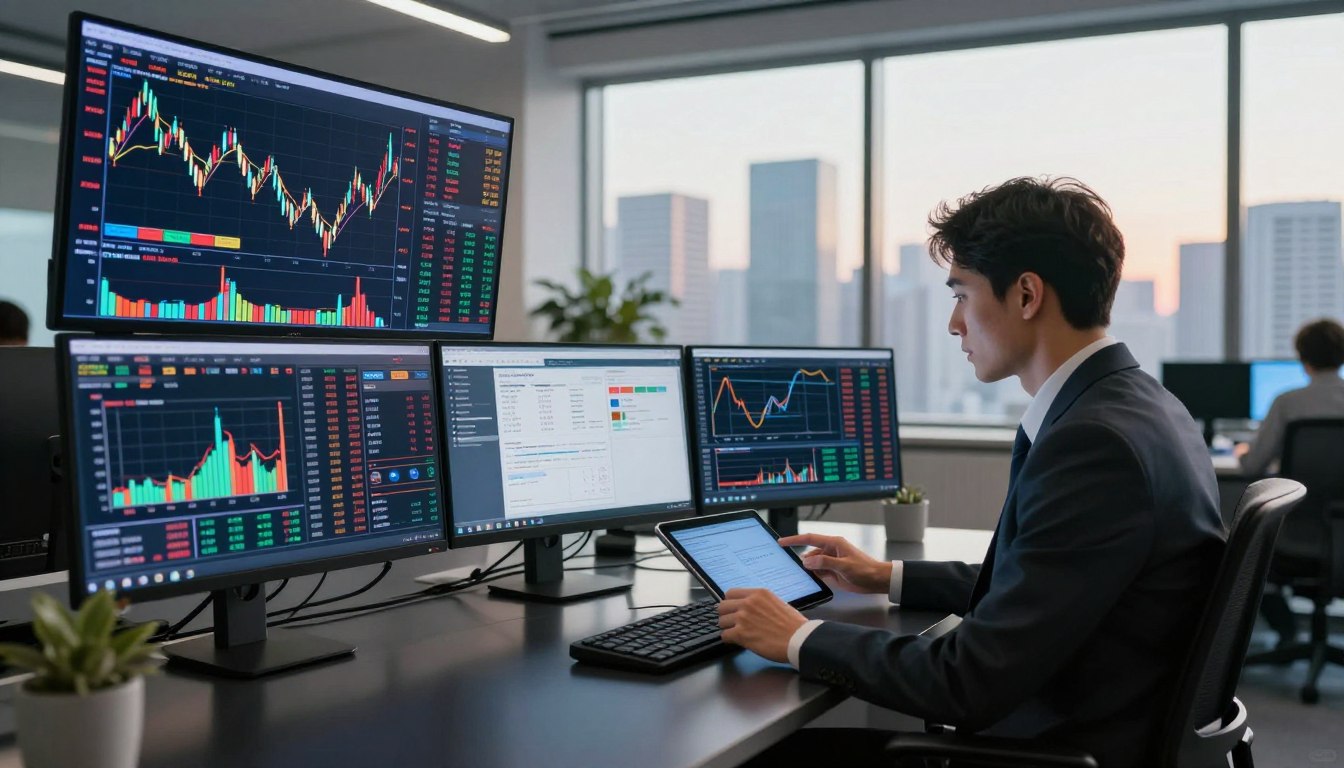
Did you know that over 10 billion equity units change hands daily across global exchanges? This massive activity fuels the modern economy and provides a path for wealth creation. We often hear about the financial world, but understanding exactly where shares of companies trade remains a mystery for many beginners.
Navigating the financial landscape requires knowing how these assets move. By identifying reliable stock market trading platforms, we gain the power to participate in global growth. It is essential to grasp the mechanics behind these exchanges to make informed decisions.

Key Takeaways
- The global financial system processes billions in daily volume.
- Knowing the right venues is vital for successful investing.
- Digital tools have made market access easier than ever before.
- Understanding exchange mechanics builds long-term investor confidence.
- Modern platforms provide the necessary data for smart decision-making.
Understanding the Basics of the Stock Market
At its core, the stock market is a platform where companies raise capital and investors buy and sell shares. This complex system is fundamental to the global economy, enabling companies to grow and investors to participate in their success.
The stock market’s operation is based on a few key concepts. First, companies must decide to become publicly traded to access a broader base of investors. Publicly traded companies are those that have issued stocks or bonds that can be bought and sold by the public.
What Defines a Publicly Traded Company
A company becomes publicly traded through an initial public offering (IPO), where it issues stocks to the public for the first time. This process allows companies to raise capital for expansion, research, and other business needs. In return, investors receive shares that represent ownership in the company.
Being publicly traded comes with both benefits and responsibilities. On one hand, it provides access to a large pool of capital and can increase a company’s visibility and credibility. On the other hand, publicly traded companies are subject to strict regulatory requirements and must disclose their financial performance regularly.
The Role of Stock Exchanges in the Global Economy
Stock exchanges are the platforms where buying and selling of shares take place. They provide a regulated environment for trading, ensuring that transactions are conducted fairly and transparently. Major stock exchanges, such as the New York Stock Exchange (NYSE) and the Nasdaq Stock Market, play a critical role in the global economy by facilitating the flow of capital.
Stock exchanges also list companies, providing them with a platform to raise capital and gain visibility. In return, these companies must comply with the exchange’s listing requirements, which often include financial health and corporate governance standards.

The role of online stock exchanges and stock market trading platforms has become increasingly important with the advent of digital trading. These platforms allow investors to buy and sell shares electronically, making it easier and faster to participate in the stock market.
Where Shares of Companies Trade in the United States
When it comes to trading shares of companies in the U.S., investors typically look to the country’s major stock exchanges. These platforms provide the infrastructure necessary for buying and selling securities.
The two primary exchanges in the U.S. are the New York Stock Exchange (NYSE) and the Nasdaq Stock Market. Both play critical roles in facilitating the trade of shares, but they have distinct characteristics.
The New York Stock Exchange Explained
The NYSE is the largest stock exchange in the world by total market capitalization of its listed companies. It is often referred to as the “Big Board.” The NYSE is known for its auction-based trading system, where prices are determined through a competitive bidding process.
Many of the largest and most well-established companies are listed on the NYSE, representing a broad range of industries. The exchange operates under a hybrid model, combining the benefits of both floor-based and electronic trading.

The Nasdaq Stock Market and Its Technological Focus
Nasdaq is the second-largest stock exchange in the world by market capitalization and is known for its electronic trading platform. It has a strong focus on technology and innovation, listing many of the world’s leading tech companies.
Nasdaq’s trading system is entirely electronic, which allows for faster execution of trades and greater transparency. The exchange is home to many growth-oriented companies, particularly in the technology sector.
| Exchange | Trading System | Notable Listings |
|---|---|---|
| NYSE | Auction-based, hybrid model | Large, established companies across various industries |
| Nasdaq | Electronic | Technology and growth-oriented companies |
Understanding the differences between these two major exchanges can help investors make informed decisions about where to trade shares of companies.
How Stock Market Trading Platforms Facilitate Transactions
The evolution of stock market trading platforms has streamlined the process of buying and selling stocks online. Today, we explore how these platforms facilitate transactions and the key players involved.
Stock market trading platforms have transformed significantly over the years. The shift from traditional floor trading to digital systems has made it easier for investors to participate in the market.
The Evolution from Floor Trading to Digital Systems
The stock market has come a long way from the days of floor trading, where brokers would physically gather to buy and sell stocks. Digital trading platforms have replaced this chaotic system with efficient, electronic transactions.
Today, investors can buy and sell stocks online with just a few clicks. This shift has not only increased the speed of transactions but also reduced costs and improved accessibility.
| Feature | Floor Trading | Digital Trading |
|---|---|---|
| Transaction Speed | Slow, dependent on human interaction | Fast, executed electronically |
| Accessibility | Limited to physical presence | Global, accessible online |
| Cost | Higher due to manual processes | Lower, automated processes |
The Role of Market Makers and Specialists
Market makers and specialists play a crucial role in facilitating smooth transactions on stock market trading platforms. They act as intermediaries, providing liquidity to the market.
Market makers are firms or individuals that quote both a buy and sell price for a security, profiting from the difference. Specialists, on the other hand, are responsible for maintaining a fair and orderly market in a particular stock.

By understanding the evolution of stock market trading platforms and the roles of key players like market makers and specialists, we can better appreciate the complexity and efficiency of modern stock trading.
Navigating Online Stock Exchanges for Modern Investors
The rise of online trading has transformed the way we invest, with various stock exchanges and trading systems now at our fingertips. As modern investors, we have the opportunity to engage with a global market, accessing a wide range of financial instruments and investment opportunities.
To navigate this complex landscape effectively, it’s crucial to understand the differences between the various types of stock exchanges and trading systems available online. Major stock exchanges, such as the New York Stock Exchange (NYSE) and the Nasdaq Stock Market, are well-established platforms that list and facilitate the trading of securities for a vast array of companies.
Key Differences Between Major Exchanges and Alternative Trading Systems
Major exchanges are characterized by their high liquidity, strict listing requirements, and regulatory oversight. In contrast, alternative trading systems (ATS) offer a more flexible and often less regulated environment for trading securities. ATS platforms cater to a variety of trading needs, including those of institutional investors and individual traders looking for specific types of investment products.
One of the key differences between major exchanges and ATS is their operational structure. Major exchanges are typically exchange-regulated, whereas ATS operate under different regulatory requirements. This distinction affects the level of transparency, the types of securities traded, and the overall trading experience.

Understanding Over-the-Counter Markets
Over-the-counter (OTC) markets represent another critical component of the online trading landscape. OTC markets facilitate the trading of securities that are not listed on the major stock exchanges. These markets are often less transparent and can involve higher risks due to the nature of the securities traded and the lack of stringent regulatory oversight.
OTC markets are used for trading a variety of financial instruments, including stocks, bonds, and derivatives. They provide a platform for companies that may not meet the listing requirements of major exchanges or prefer the less stringent regulatory environment.
As we navigate online stock exchanges and trading systems, it’s essential to be aware of the stock market trading hours and how they impact our trading activities. Understanding the operational hours of different exchanges and markets helps us plan our investment strategies more effectively.
How to Buy and Sell Stocks Online Safely
As online stock trading continues to grow in popularity, understanding how to navigate this space safely is more important than ever. With the convenience of digital platforms, investors can now easily buy and sell stocks from anywhere. However, this convenience also comes with risks that need to be managed.
To ensure a safe and successful online trading experience, it’s essential to start with a solid foundation. This involves choosing a reputable brokerage account, understanding the different types of orders, and being aware of the associated risks.
Choosing a Reputable Brokerage Account
Selecting a reliable brokerage firm is the first step in safe online stock trading. A reputable broker provides a secure platform, competitive fees, and quality customer service. When evaluating brokers, consider factors such as:
- Regulatory compliance and reputation
- Security measures, including encryption and two-factor authentication
- Trading fees and commissions
- User-friendly trading platforms and mobile apps
- Quality of customer support
“A good broker is like a trusted advisor; they provide the tools and support you need to make informed investment decisions,” says a seasoned investor. When choosing a broker, it’s crucial to do your research and read reviews from other investors.

The Mechanics of Placing Market and Limit Orders
Understanding how to place orders is vital for successful online trading. The two primary types of orders are market orders and limit orders. A market order executes a trade at the current market price, while a limit order allows you to set a specific price at which you want to buy or sell a stock.
For example, if you want to buy shares of a company currently trading at $50, you can place a limit order at $48. The trade will only execute if the stock price reaches $48 or lower. This level of control can help you manage your investments more effectively.
| Order Type | Description | Use Case |
|---|---|---|
| Market Order | Executes at the current market price | When you want to buy or sell immediately |
| Limit Order | Executes at a specified price or better | When you want to control the price of your trade |
By understanding the mechanics of different order types and choosing a reputable brokerage account, you can significantly enhance your online trading experience. As the saying goes, “Knowledge is power,” and in the world of online stock trading, it’s the key to making informed decisions and achieving your financial goals.
The Importance of Stock Market Trading Hours
Investors need to be aware of the stock market trading hours to maximize their opportunities and minimize risks. The stock market’s operational hours dictate when trades can be executed, and understanding these hours is fundamental to navigating the markets effectively.
Regular Trading Sessions and Their Significance
Regular trading sessions are the core hours during which the stock market is open, and the majority of trading activity occurs. For major exchanges like the New York Stock Exchange (NYSE) and Nasdaq, regular trading hours are typically between 9:30 AM and 4:00 PM Eastern Time (ET). During these hours, the market is most liquid, and transactions are executed at the best available prices. The significance of these hours lies in their ability to provide a stable and active market environment, where investors can buy and sell shares with relative ease.
- Higher liquidity due to the presence of more market participants
- Tighter bid-ask spreads, reducing transaction costs
- Greater market efficiency, as prices reflect all publicly available information
After-Hours and Pre-Market Trading Risks
After-hours and pre-market trading refer to the periods outside regular trading hours when investors can still buy and sell stocks. While these sessions offer flexibility, they also come with significant risks. The lower liquidity and higher volatility during these periods can lead to larger price swings and increased transaction costs.
- Increased volatility due to lower trading volumes
- Wider bid-ask spreads, making trades more expensive
- Lower liquidity, potentially leading to delayed or unexecuted trades
In conclusion, understanding the stock market trading hours is essential for investors to make informed decisions. By recognizing the significance of regular trading sessions and being aware of the risks associated with after-hours and pre-market trading, investors can better navigate the complexities of the stock market.
Regulatory Oversight and Investor Protection
As we navigate the complex world of online stock exchanges and stock market trading platforms, it’s essential to understand the regulatory bodies that oversee these markets. Regulatory oversight is crucial for maintaining fair, transparent, and efficient markets.
The regulatory framework governing stock market trading platforms is designed to protect investors and maintain market integrity. This framework is enforced by several key regulatory bodies.
The Role of the Securities and Exchange Commission
The Securities and Exchange Commission (SEC) plays a vital role in overseeing online stock exchanges. The SEC’s primary mission is to protect investors, maintain fair and efficient markets, and facilitate capital formation. To achieve this, the SEC sets and enforces rules for stock market trading platforms, ensuring that they operate in a fair and transparent manner.
The SEC’s regulatory oversight includes reviewing registration statements for new securities, enforcing securities laws, and regulating the major participants in the securities industry. By doing so, the SEC helps to maintain investor confidence in the markets.
How FINRA Monitors Market Integrity
The Financial Industry Regulatory Authority (FINRA) is another critical regulatory body that oversees stock market trading platforms. FINRA’s role is to protect investors by ensuring that broker-dealers operate fairly and honestly. FINRA monitors trading activity, enforces trading rules, and provides investor education.
FINRA’s oversight helps to detect and prevent market manipulation, insider trading, and other forms of misconduct. By maintaining the integrity of the markets, FINRA contributes to a fair and transparent trading environment for all investors.
In conclusion, the regulatory oversight provided by bodies like the SEC and FINRA is essential for the functioning of online stock exchanges and stock market trading platforms. Their work ensures that markets operate with integrity, protecting investors and facilitating trust in the financial system.
How to Invest in Shares Online as a Beginner
For those looking to start their investment journey, understanding how to invest in shares online is a crucial first step. The process involves several key considerations to ensure a successful and stress-free experience.
Researching Companies Before You Buy
Before investing in any company, it’s essential to conduct thorough research. This involves analyzing the company’s financial health, understanding its business model, and staying updated on market trends.
- Look for companies with a strong track record of performance.
- Evaluate the management team’s experience and track record.
- Consider the industry’s growth potential and competitive landscape.
Diversification Strategies for New Portfolios
Diversification is a critical strategy for managing risk in your investment portfolio. By spreading your investments across different asset classes and sectors, you can mitigate potential losses.
| Asset Class | Risk Level | Potential Return |
|---|---|---|
| Stocks | High | High |
| Bonds | Low | Low-Moderate |
| Real Estate | Moderate | Moderate-High |
By following these guidelines and maintaining a well-informed approach, beginners can confidently start their journey in online stock investing.
The Impact of Technology on Where Shares of Companies Trade
Technology has profoundly impacted the stock market, changing how shares are bought and sold on online stock exchanges. We have witnessed a significant transformation in the way shares of companies are traded, with technology playing a pivotal role in this evolution. This transformation has not only enhanced the efficiency of transactions but has also opened up new avenues for investors to participate in the stock market.
High-Frequency Trading and Its Market Influence
High-frequency trading (HFT) has emerged as a significant force in the stock market, leveraging advanced algorithms and high-speed data connections to execute trades at incredibly fast speeds. This form of trading has been both praised for its ability to provide liquidity and criticized for its potential to cause market volatility. We observe that HFT firms use complex algorithms to analyze market data and identify profitable trades, often holding positions for mere seconds.
The influence of HFT on the market is multifaceted. On one hand, it has been argued that HFT improves market efficiency by tightening bid-ask spreads and enhancing liquidity. On the other hand, critics argue that it can lead to market instability, as evidenced by events like the 2010 Flash Crash.
The Rise of Mobile Trading Applications
The proliferation of mobile trading applications has democratized access to the stock market, allowing investors to buy and sell shares on the go. These applications have made it possible for a new generation of investors to participate in the market, providing them with real-time market data and the ability to execute trades from anywhere.
We have seen a significant shift towards mobile trading, with many brokerage firms offering sophisticated mobile apps that rival their desktop counterparts. This trend is expected to continue, with advancements in technology further enhancing the mobile trading experience.
Global Connectivity and International Stock Trading
The globalization of financial markets has opened up new avenues for US investors to explore international stock trading, offering a chance to tap into emerging markets and diversify their investments. As we continue to navigate the complexities of the global economy, understanding how to access foreign markets and the instruments that facilitate this access is crucial.
With the rise of global connectivity, US investors can now easily invest in shares of companies listed on foreign exchanges. This not only broadens their investment horizons but also provides opportunities to capitalize on growth in various sectors worldwide. As Warren Buffett once said, “Price is what you pay. Value is what you get.” Investing internationally can help investors get more value by diversifying their portfolios.
Accessing Foreign Markets
US investors can access foreign markets through various channels. One common method is by opening an international brokerage account with a reputable firm that offers global trading capabilities. This allows investors to directly purchase shares on foreign exchanges. However, this method may involve complexities such as currency conversion and understanding local market regulations.
Another approach is through the use of financial instruments designed to simplify international investing. One such instrument is the American Depositary Receipt (ADR).
Understanding American Depositary Receipts
American Depositary Receipts (ADRs) represent a specified number of shares in a foreign company and are traded on US stock exchanges. They are denominated in US dollars, eliminating the need for currency conversion. ADRs simplify the process of investing in foreign companies, as they are subject to the same trading rules and regulations as US stocks.
For instance, if a US investor wants to invest in a British company like BP plc, they can buy ADRs of BP on a US exchange, rather than navigating the London Stock Exchange. This makes it easier for investors to diversify their portfolios with international stocks.
“ADRs allow US investors to invest in foreign companies with the same ease as investing in US companies, thereby expanding their investment universe.”
To invest in ADRs, US investors can use their existing brokerage accounts, as ADRs are traded on major US exchanges like the NYSE and Nasdaq. This accessibility makes it easier for investors to incorporate international stocks into their investment strategies.
Analyzing Market Liquidity and Trading Volume
As we delve into the world of stock trading, it becomes evident that market liquidity and trading volume play pivotal roles. These factors are crucial for understanding the dynamics of the stock market and making informed investment decisions. In this section, we will explore the significance of market liquidity and trading volume, particularly in the context of stock market trading platforms and during stock market trading hours.
Market liquidity refers to the ability to buy or sell a stock quickly and at a fair price. It is a measure of how easily a stock can be converted into cash without affecting its market price. High liquidity means that there are many buyers and sellers actively trading the stock, resulting in tighter bid-ask spreads and lower transaction costs.
Why Volume Matters for Price Discovery
Trading volume is a key indicator of market activity and liquidity. It represents the number of shares traded during a given period. High trading volume is often associated with significant price movements, as it indicates a strong interest in the stock. This interest can be driven by various factors, including earnings announcements, economic indicators, or market trends.
The relationship between trading volume and price discovery is fundamental. Price discovery is the process by which the market determines the price of a security based on supply and demand. High trading volume contributes to more efficient price discovery because it reflects a broader consensus among market participants about the stock’s value.
The Relationship Between Liquidity and Transaction Costs
Liquidity has a direct impact on transaction costs. In highly liquid markets, transaction costs are lower because trades can be executed quickly and with minimal impact on the market price. Conversely, in illiquid markets, transaction costs are higher due to wider bid-ask spreads and the potential for significant price movements when large trades are executed.
For investors, understanding the liquidity of a stock is essential for managing transaction costs and achieving their investment objectives. By choosing stocks with high liquidity, investors can minimize the costs associated with buying and selling, thereby maximizing their returns.
The Role of Institutional Investors in Market Dynamics
As we navigate the complex world of online stock exchanges, it’s essential to understand the significant role institutional investors play in shaping market dynamics. Institutional investors, including mutual funds, pension funds, and hedge funds, manage large pools of capital, giving them considerable influence over the markets.
These investors are not just passive participants; they are active players who can significantly impact stock prices through their buying and selling activities. Their investment decisions are often based on thorough research and analysis, making their actions closely watched by other market participants.
How Mutual Funds and Pension Funds Influence Prices
Mutual funds and pension funds are among the largest institutional investors. They pool money from individual investors and invest it in a diversified portfolio of stocks, bonds, and other securities. When these funds decide to invest in or divest from a particular stock, it can lead to significant price movements.
For instance, if a large mutual fund decides to buy a substantial stake in a company, it can drive up the stock price. Conversely, if a pension fund decides to sell its holdings in a company, it can lead to a decrease in the stock price.
- Scale of Investment: The large scale of their investments means that even small changes in their portfolios can have a significant impact on the market.
- Research and Analysis: These funds often have access to extensive research and analysis, enabling them to make informed investment decisions that can influence market trends.
The Impact of Algorithmic Trading Strategies
Algorithmic trading, which involves using computer programs to execute trades based on predefined criteria, is another significant aspect of institutional investors’ influence on the market. These algorithms can analyze vast amounts of data quickly and make trades at speeds that are not humanly possible.
High-frequency trading (HFT) is a type of algorithmic trading that involves executing a large number of trades in a fraction of a second. HFT firms use powerful computers to analyze market data and identify profitable trades, often holding positions for just a few seconds.
The impact of algorithmic trading strategies on the market can be significant. They can contribute to market liquidity and help in price discovery. However, they can also lead to increased volatility and are sometimes blamed for flash crashes.
“Algorithmic trading has become a dominant force in the financial markets, with some estimates suggesting that it accounts for over half of all trading activity.”
Common Misconceptions About Stock Trading Locations
As we navigate the complex landscape of stock market trading platforms, it’s essential to address common misconceptions about where shares of companies trade. The world of stock trading has evolved significantly, and understanding the nuances between different trading locations is crucial for investors.
“The stock market is not just a place; it’s a mechanism for companies to raise capital and for investors to participate in the growth of businesses,” as noted by financial experts. This quote underscores the importance of clarity regarding how and where trading occurs.
Debunking Myths About Physical Versus Virtual Exchanges
One of the most prevalent myths is that stock trading is confined to physical locations like the New York Stock Exchange (NYSE). However, the reality is that a significant portion of trading now occurs on virtual exchanges and through electronic platforms.
The distinction between physical and virtual exchanges is not just about the location; it’s about the mechanism and accessibility. Virtual exchanges offer greater flexibility and accessibility for investors worldwide, allowing for 24/7 trading in some capacities.
- Physical exchanges provide a tangible floor for trading, with market makers and specialists facilitating transactions.
- Virtual exchanges, on the other hand, operate entirely online, matching buy and sell orders electronically.
Clarifying the Role of Clearing Houses
Another critical aspect often misunderstood is the role of clearing houses in stock trading. Clearing houses act as intermediaries between buyers and sellers, ensuring that transactions are settled efficiently and securely.
“Clearing houses are the backbone of modern financial markets, providing the necessary infrastructure for the smooth operation of trades.”
They guarantee the settlement of trades, manage the risk associated with transactions, and facilitate the transfer of funds and securities. This process is crucial for maintaining the integrity and stability of financial markets.
By understanding the roles of both physical and virtual exchanges, as well as the critical function of clearing houses, investors can better navigate the complexities of where shares of companies trade.
Security Measures for Online Share Trading
The security of our online trading accounts is paramount as we navigate the world of buying and selling stocks online. As we continue to invest in shares online, it’s essential to understand the measures we can take to protect our investments.
Protecting Your Account with Two-Factor Authentication
One of the most effective ways to secure our online trading accounts is by enabling two-factor authentication (2FA). This adds an extra layer of security beyond just a password. With 2FA, even if our password is compromised, our account remains secure because a second form of verification is required to access it.
- Go to our brokerage account settings
- Select the option to enable 2FA
- Follow the prompts to set up a second form of verification, such as a code sent to our phone or a biometric scan
By doing so, we significantly reduce the risk of unauthorized access to our accounts.
Recognizing and Avoiding Investment Scams
Another critical aspect of securing our online trading activities is being able to recognize and avoid investment scams. These scams can come in various forms, including unsolicited investment offers, fake online trading platforms, and phishing attempts.
- Be cautious of unsolicited investment advice or offers that seem too good to be true
- Verify the legitimacy of any online trading platform before investing
- Never provide sensitive information in response to unsolicited emails or messages
By being vigilant and taking these precautions, we can protect ourselves from potential scams and ensure a safer online trading experience.
Future Trends in Where Shares of Companies Trade
As we look to the future, the landscape of stock trading is poised for significant changes. The way shares are traded is evolving, driven by technological advancements and changing investor needs. In this section, we’ll explore two key trends that are likely to shape the future of stock trading: the potential impact of blockchain technology and the shift toward 24/7 market accessibility.
Blockchain Technology’s Potential Impact
Blockchain technology has been making waves across various industries, and stock trading is no exception. Its potential to increase transparency, security, and efficiency in trading processes is significant. By utilizing a decentralized ledger, blockchain can facilitate real-time settlement of trades, reducing the need for intermediaries and potentially lowering transaction costs.
Moreover, blockchain technology can enhance the integrity of stock trading by providing an immutable record of transactions. This could lead to improved regulatory compliance and reduced risk of fraud. As the technology continues to mature, we can expect to see more innovative applications in the stock trading space.
| Potential Benefits | Description |
|---|---|
| Increased Transparency | Blockchain’s decentralized ledger provides a clear and transparent record of all transactions. |
| Enhanced Security | The immutable nature of blockchain reduces the risk of fraud and cyber attacks. |
| Improved Efficiency | Real-time settlement of trades reduces the need for intermediaries and lowers transaction costs. |
Shifting Toward 24/7 Market Accessibility
Another significant trend is the move toward continuous market accessibility. Traditional stock market trading hours are being challenged by the demand for around-the-clock trading. With the rise of global investing and the need for timely reactions to news and events, the traditional 9-to-5 trading day is becoming increasingly restrictive.
The shift toward 24/7 market accessibility is being driven by advancements in technology and the growing popularity of online stock exchanges. This trend is likely to continue, with more exchanges and trading platforms offering extended hours or continuous trading capabilities. As a result, investors will have greater flexibility to respond to market movements at any time.
- Increased flexibility for investors
- Better responsiveness to global market events
- Potential for increased trading volumes
As we move forward, it’s clear that the future of stock trading will be shaped by technological innovation and changing investor needs. By understanding these trends, we can better navigate the evolving landscape of online stock exchanges and stock market trading hours.
Conclusion
As we conclude our exploration of where shares of companies trade, it’s clear that understanding the intricacies of stock market trading platforms is crucial for navigating today’s financial landscape. We have discussed the evolution of stock exchanges, from traditional floor trading to modern digital systems, and highlighted the significance of major exchanges like the New York Stock Exchange and Nasdaq.
Our journey through the world of stock trading has also touched upon the importance of regulatory oversight, the role of institutional investors, and the impact of technology on market dynamics. As we move forward, it’s essential to recognize that the landscape of where shares of companies trade will continue to evolve, driven by advancements in technology and changes in global market connectivity.
By staying informed about these developments and understanding how stock market trading platforms facilitate transactions, we can make more informed investment decisions and better navigate the complexities of the modern financial world.
FAQ
Where exactly do the shares of companies trade in today’s digital world?
In the modern financial landscape, where shares of companies trade is primarily on regulated exchanges such as the New York Stock Exchange (NYSE) and the Nasdaq. These venues act as centralized hubs where buyers and sellers meet to exchange ownership in companies like Apple, Disney, or JPMorgan Chase. While some trading still occurs on physical floors, the vast majority of transactions are now processed through sophisticated online stock exchanges.
What are the main differences between the NYSE and the Nasdaq?
The NYSE is often associated with “blue-chip” companies and historically utilized a floor-trading model with human specialists. In contrast, the Nasdaq was the world’s first electronic exchange and is the preferred home for many tech-heavy firms like Microsoft and Amazon. Both serve as primary stock market trading platforms that ensure transparency and liquidity for our investments.
How do stock market trading platforms facilitate our daily transactions?
These platforms act as the digital infrastructure that connects our brokerage accounts to the broader market. When we use stock market trading platforms like Fidelity or Charles Schwab, our orders are routed to exchanges or market makers who facilitate the trade. This evolution from physical shouting matches to digital systems allows us to execute trades in milliseconds from almost anywhere in the world.
Is it possible to buy and sell stocks online safely without a professional broker?
While we don’t need a personal floor broker, we still require a reputable brokerage firm to access the markets. To buy and sell stocks online safely, we should always choose platforms that are members of SIPC and regulated by the SEC. By using tools like two-factor authentication on accounts with Vanguard or E*TRADE, we can protect our capital while participating in the global economy.
What should we know about stock market trading hours before placing an order?
Standard stock market trading hours for major U.S. exchanges are 9:30 AM to 4:00 PM Eastern Time, Monday through Friday. While many online stock exchanges offer “pre-market” and “after-hours” sessions, we should be aware that these periods often have lower liquidity and higher volatility, which can lead to unpredictable price swings compared to the regular session.
How can a beginner learn how to invest in shares online effectively?
The best way to start learning how to invest in shares online is to focus on research and diversification. We recommend starting with companies we know and understand, such as Alphabet or Visa, and utilizing the educational resources provided by reputable brokerages like TD Ameritrade. By building a diversified portfolio, we can mitigate risk as we navigate our early days in the market.
What are Over-the-Counter (OTC) markets, and how do they differ from major exchanges?
OTC markets are where shares of companies trade when they do not meet the strict listing requirements of the NYSE or Nasdaq. These are often smaller or developing companies. While they offer opportunities, they generally have less transparency and lower volume, making them riskier for us than stocks listed on major online stock exchanges.
How do institutional investors like mutual funds influence the market?
Large institutions, such as BlackRock or Vanguard, manage billions of dollars in mutual funds and pension funds. Because they trade such massive volumes, their movements significantly impact price discovery and market liquidity. Their use of high-frequency trading and algorithmic strategies often dictates the short-term momentum on the stock market trading platforms we use every day.
What role does the SEC play in protecting our investments?
The Securities and Exchange Commission (SEC) is the “watchdog” of the financial markets. Their primary mission is to protect us from fraud and ensure that where shares of companies trade remains a fair and orderly environment. They require public companies to disclose meaningful financial information, allowing us to make informed decisions when we buy and sell stocks online.
What is an American Depositary Receipt (ADR)?
An ADR is a way for us to invest in foreign companies like Toyota or Sony without having to trade directly on a foreign exchange. These are certificates issued by a U.S. bank that represent shares in a foreign stock and trade on U.S. online stock exchanges just like domestic shares, denominated in U.S. dollars.